5. Anatomy of a Parquet File
This is a minimal overview of Parquet. For full details, see the Apache Parquet documentation.
5.1 The schema
Parquet files contain a physical data schema defining how their data columns are encoded as bytes on disk. This schema supports arbitrary levels of nullability, nesting (groups), and repetition (lists). These physical data types may also be mapped to one or more logical types. Parquet stores all data in little endian byte order.
There is a broader many-to-many mapping between Parquet schemas and Apache Arrow schemas. Arrow supports many types that Parquet does not, but the two share a common abstraction of columnar storage with per-value nullability. Although they represent these concepts differently, conversion between them is straightforward. In Parquet group nodes are simply a name along the column's path and do not have a physical layer in storage. In Arrow, a group's analogous struct is a node in the schema and its own index. The same applies to list-valued columns.
5.2 The metadata key–value pairs
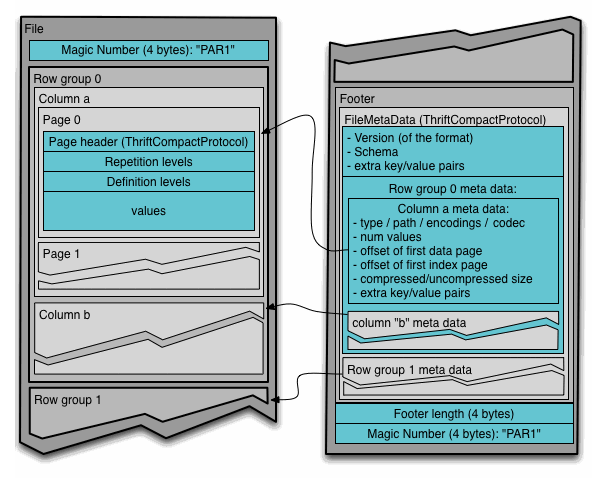
At the end of a Parquet file is a footer containing user-defined metadata along with the file's schema, offsets, and search indices. This user-defined metadata is stored as key–value pairs, which makes it well suited to carrying light-weight, immediately useful metadata that does not make sense to force into the data columns. mzPeak uses this footer to record facet-level metadata - most notably for the array index.
5.3 The columnar data
Parquet is a strongly typed binary columnar format with layered, blocked compression that permits a degree of random access. It is often used in concert with Apache Arrow's in-memory structured columnar format.
Support both 32-bit and 64-bit collection types in Arrow
Because some languages have no concept of 64-bit addresses, all
implementations MUST handle both the large_* and non-large_*
variants of collection types: list, string, and binary.
When stored on disk, columns are are encoded with one of a small list of light-weight encodings described at https://parquet.apache.org/docs/file-format/data-pages/encodings/. and then compressed using a general purpose compression codec listed at https://parquet.apache.org/docs/file-format/data-pages/compression/. Writers may need to take care when configuring column encodings because common Parquet libraries will assume dictionary encoding is enabled and ignore any requested encoding unless it is separately disabled. In addition, some Parquet libraries will, if the dictionary size limit is exceeded fall back to the "plain" encoding, which does nothing to make the data more compressible. Dictionaries are tied to a row group, not the entire file, and will write their values once using the "plain" encoding.
5.3.1 Row groups and pages
A Parquet file is divided into row groups, each of which stores a horizontal slice of every column as a column chunk. Column chunks are further divided into pages, the smallest unit of compression and encoding. This hierarchy is what lets a reader retrieve a narrow slice of a large file: it can locate the row group and pages that hold the rows of interest and read only those.
Choosing row group and page sizes trades compression ratio against random-access granularity - larger data pages compress better but make fine-grained reads coarser as shown in the image below. Reading spectrum 5 requires decoding and decompressing the ion mobility values for spectra 0-17, and the m/z values for spectra 0-7. Larger row groups take (substantially) more memory to write as all constituent data pages have to be buffered before columns are written out all at once, and can cause some dictionaries to exceed their default size limits for highly variable values like m/z.

Recommendations:
When size is not a substantial issue:
- 1 MB of data per data page
- 1 million rows per row group
When size is important:
- 8MB of data per data page
- 4-8 million rows per row group
Note
When writing any signal data layout, the writer SHOULD write each row with the same entity index to the same row group. This makes reading efficient as only one row group needs to be visited to load a single entity.
5.3.2 Index levels
When writing an mzPeak archive, the writer MUST write a page index and row group-level column statistics. Most libraries that write Parquet support writing the page index even if they do not themselves use it when reading.
The row group-level column statistics stores the minimum and maximum values in the column across the entire row group. These are useful for deciding if the reader needs to even visit a row group, saving read planning effort, and are easily accessible to all Parquet implementations. Scanning these statistics is a good and cheap way to determine things like the minimum and maximum m/z observed, the time range covered in the run, or the highest MS level used.
The page index records per-data page minimum and maximum values, which is what makes predicate-driven
reads (for example, "only pages whose spectrum_index covers 5000–5100") efficient. Not all Parquet
libraries have reliable access to the page index yet.
Parquet also supports storing a bloom filter per column per row group, but this is usually disabled by
default. A bloom filter's size-to-false positive ratio makes them expensive to use for highly variable
values, and they are needless for columns with very high repetition when reading them is inexpensive.
For very, very large metadata tables, it may still be useful to use them for tracking string values like
the spectrum.id or precursor.activation.dissociation_method columns. Writers MAY choose to write
bloom filters, but readers MUST be prepared to read data without them.