
Benchmarks
How mzPeak's size and access claims were measured, and how to reproduce them. The headline figures come from the peer-reviewed white paper (Van Den Bossche et al., J. Proteome Res. 2025 — see How to cite); the public corpus is the reproducible artifact: every dataset ships each .mzpeak alongside its original, so anyone can re-measure the ratios.
Compression — per instrument
File size of the mzPeak archive as a fraction of the equivalent mzML (lower is better), across seven instrument classes. Peak type (profile / centroid) is preserved on conversion, so these are lossless conversions, not down-sampling.
| Instrument | mzML | mzPeak | mzPeak ÷ mzML |
|---|---|---|---|
| Thermo LTQ FT Ultra (FT-ICR) | 30.2 MB | 5.5 MB | 0.18× |
| Thermo Orbitrap Velos | 429.2 MB | 101.5 MB | 0.24× |
| Thermo Fusion Lumos | 588.6 MB | 156.5 MB | 0.27× |
| Thermo LTQ XL (ion trap) | 173.5 MB | 55.6 MB | 0.32× |
| Bruker timsTOF Pro | 1386.5 MB | 677.2 MB | 0.49× |
| Thermo Orbitrap Astral | 6118.4 MB | 3359.4 MB | 0.55× |
| SCIEX ZenoTOF 7600 | 89.8 MB | 50.9 MB | 0.57× |
Across this set, mzPeak is 0.18×–0.57× of the equivalent mzML, averaging ~0.37× — and since mzML is XML text that frequently inflates past the vendor RAW file, mzPeak also lands below the original RAW.
Compression — whole corpus
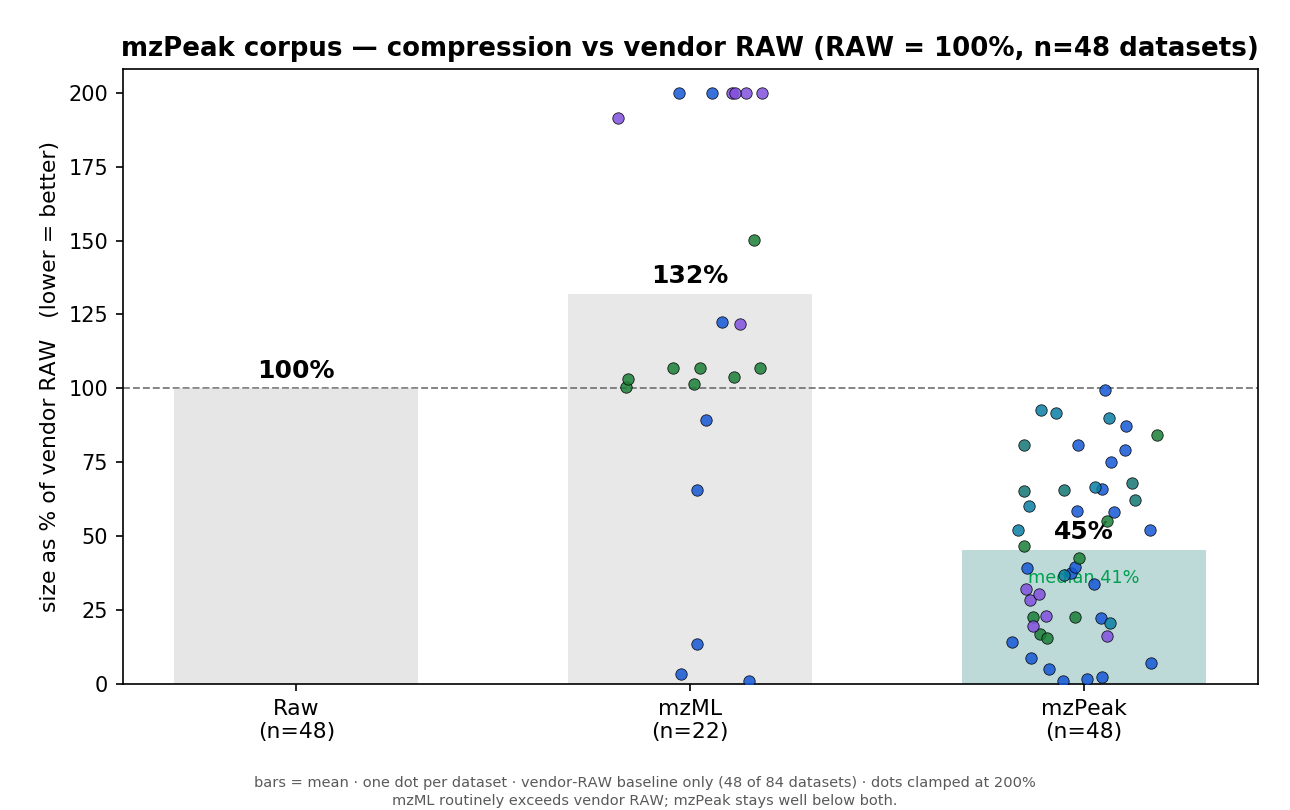
Across the broader corpus, mzPeak is on average about 53 % of the original file it was made from — the vendor RAW where available, else the source mzML — and far smaller for imaging and study-design data. (mzML, by contrast, routinely exceeds 100 % of RAW.)
Random access
mzPeak stores spectra in Apache Parquet inside a ZIP, with a small JSON index — so a reader can fetch one spectrum from a multi-GB file directly over HTTP range requests, without downloading the whole file. The white paper reports opening a 3 GB file and reading a spectrum in under ~2 s (local and from remote object storage). The full test setup — hardware, network, reader version, and query definition — is in the paper; treat the corpus below as the reproducible size/access artifact rather than a re-statement of those timings.
Reproduce it yourself
- Pick any dataset from the public corpus — ~79 real datasets across six vendors and seven instrument classes, each
.mzpeaknext to its original. - Compare the file sizes directly (the index lists both).
- Convert your own mzML with mzML2mzPeak and measure the result — conversion is lossless (shared PSI-MS controlled vocabulary).
- Stream a single spectrum over HTTP with the mzPeak Viewer or any reference library to see range-based random access in action.
Methodology and the primary measurements are documented in the white paper (10.1021/acs.jproteome.5c00435).